
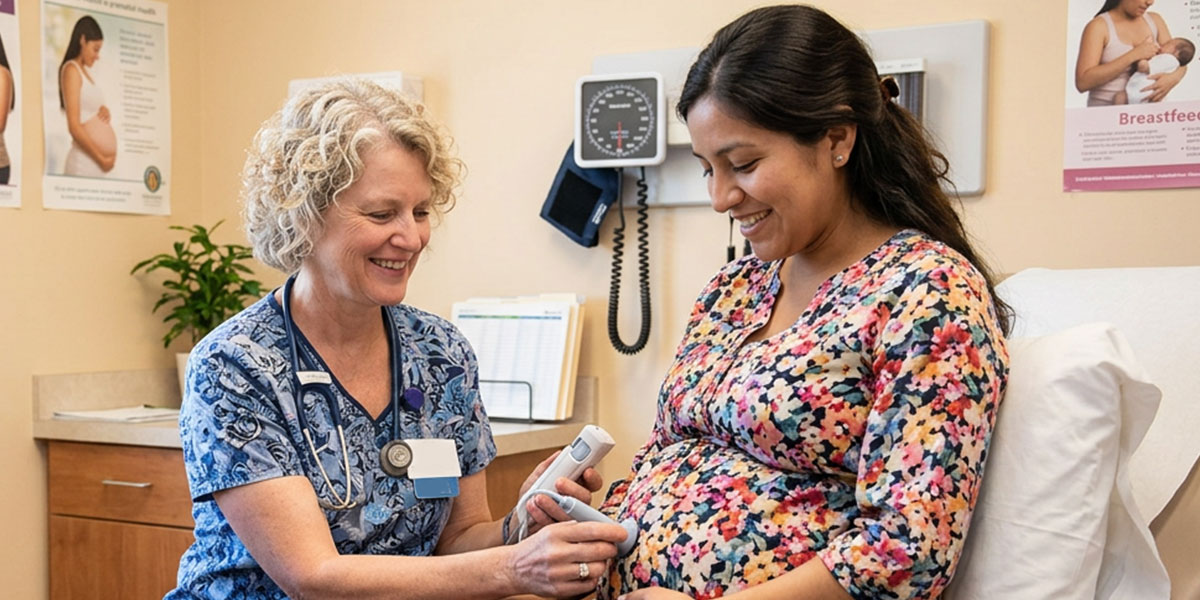
At Samuel U. Rodgers Health Center, a federally qualified health center in Kansas City, Missouri, pregnant patients do not just see a provider. They walk into a medical home where prenatal care, dental services, behavioral health, vision, WIC, community health workers, and essential services and supplies converge under one roof. It is the kind of coordinated model that the healthcare systems across the country talk about building. At Sam Rodgers, it already exists, and at the center of its maternal health work is a provider whose title still surprises people when they hear it in this setting.
Ashley Tuttle, DNP, APRN, CNM, is a midwife at Sam Rodgers. It is an uncommon role in an uncommon setting. While certified nurse-midwives are among the provider types authorized to deliver care at federally qualified health centers, relatively few employ them.
“We look at care very holistically,” Tuttle said. “I personally bring forth a lot of that trauma-informed care.”
The need for that care is well documented. According to the Missouri Department of Health and Senior Services, 80% of pregnancy-related deaths in the state between 2018 and 2022 were determined to be preventable, with the vast majority occurring in the postpartum period. The 2025 March of Dimes Report Card gave Missouri a “D” grade for preterm births, with more than 7,400 babies born before 37 weeks in 2024. Kansas City earned the same grade, with a preterm birth rate of 10.9% that worsened from the prior year.
Tuttle came to midwifery through an unconventional path. She spent nearly seven years in the emergency department at the University of Kansas Health System, where she became a forensic nurse examiner conducting sexual assault exams. That work sharpened a focus she carries into every prenatal appointment.
“I really found interest in caring for women and just making everything very trauma-informed, making it feel safe for them,” she said. During her doctoral program at the University of Kansas, she developed a protocol for emergency departments to conduct trauma-informed pelvic exams, providing scripting and techniques designed to prevent providers from inadvertently triggering patients during vulnerable moments.
That sensibility shows up in small, deliberate choices at Sam Rodgers. Tuttle does not use stirrups during pelvic exams, opting for the table extension instead. “I feel like it gives people more control over their care,” she said. “If they feel like they can move and they’re not stuck somewhere, it changes the whole picture.” She works alongside a physician assistant, a women’s health nurse practitioner, and an OB-GYN, but her scope of practice and clinical philosophy are distinct.
What sets Sam Rodgers apart from a private practice or hospital-based clinic is the infrastructure surrounding that clinical encounter. Under the medical home model, the moment a patient’s pregnancy is confirmed, a referral process begins. That support also includes doula services through The MaIH Center at Sam Rodgers, operated by Altruism, Inc., which co-locates prenatal, birth, and postpartum doula care alongside Sam Rodgers’ clinical team.
“It makes you feel really empowered as a provider, because a lot of places you work don’t offer that,” Tuttle said. “You just kind of have to do what you can with what you got, and it’s not near as robust as what we have here.”
More Than Another Prenatal Appointment
That coordination becomes especially critical for the patients Tuttle sees most often. Many of them are navigating the American healthcare system for the first time, and some have never delivered a baby in the United States. “It can be quite different from different countries, so just giving that background to them of what to expect is really important,” she said. For many, the word “midwife” itself is a bridge.
While titles like nurse practitioner do not translate easily across cultures and languages, midwifery is a concept most of her patients recognize immediately. “It kind of sets them at ease a little bit to hear that I’m a midwife because they actually know what that is,” she said. “Most countries overall probably use a lot more midwifery care than any other kind of care, especially during pregnancy.”
Building trust with patients who arrive wary of the healthcare system takes patience, transparency, and time that Tuttle is deliberate about protecting. She described a recent encounter with a patient who had experienced bleeding in early pregnancy and visited an emergency room, where she received care that left her confused and frightened. The patient arrived at Sam Rodgers requesting a transfer to a larger center with a physician. With the help of an in-person interpreter, Tuttle walked through the visit step by step, located the ultrasound results, and explained everything in plain terms. “Eventually, after I explained everything, they were okay with staying with us as the provider and not wanting to transfer their care,” she said.
That kind of relationship-building extends beyond clinical encounters. Tuttle and a women’s health nurse practitioner at Sam Rodgers run a group prenatal care program for Spanish-speaking patients. Neither of them speaks Spanish, but with interpreter support, they have built a space where patients feel comfortable asking the questions they might otherwise hold back. “One exercise involves patients writing anonymous questions on sticky notes and dropping them into a bowl. ‘I get a lot of questions about traditions and practices that I’m not always familiar with,’ Tuttle said. ‘But I have to figure out what it is so I can get the correct answer.'”
The cultural practices her patients bring to prenatal care are ones Tuttle navigates usinga framework rooted in shared decision-making. She described patients from Mexico who wear a safety pin with a red ribbon over the belly as a form of protection, a tradition she respects without hesitation. Other conversations require more nuance, like discussing the importance of earlier and more frequent prenatal visits with patients from countries where late entry to care is the norm, or explaining what an epidural is to someone who has never encountered one.
The postpartum period is where Tuttle focuses particular energy, and where the data suggests Missouri’s maternal health crisis is most acute. According to the Pregnancy-Associated Mortality Review Report published in 2025, 82% of pregnancy-related deaths in Missouri occurred in the postpartum period, with 43% happening after the six-week mark. Every pregnancy-related death attributed to mental health conditions, including substance use disorders, was determined to be preventable.
Tuttle said she emphasizes postpartum follow-up long before the baby arrives, scheduling early check-ins for patients she is concerned about and making sure every patient understands that the health center remains available to them. “Even if they’re doing well mentally today, they’re at risk for the next year,” she said. “I can help them navigate that.”
For some patients, the postpartum period also presents a coverage gap. Depending on eligibility category, some patients lose Medicaid coverage after delivery, even though Missouri has recently expanded postpartum coverage to a full year for many enrollees. Their babies may still qualify for coverage through CHIP, but navigating that transition is one more thing Tuttle helps families prepare for. Tuttle said she makes a point of discussing this before the baby arrives so patients know that Sam Rodgers, with its sliding-scale fee structure, remains an option.
“I think it’s important for them to know that they can get care that’s not very expensive for them,” she said. “That they trust us and they’ve met us before, and that if they’re having a problem, they know where to come. I think that’s really important, especially as we look at the morbidity and mortality rates in this country.”
Your Midwife from Adolescence to Menopause
There is one more thing Tuttle wants people to understand about midwifery, and it has nothing to do with pregnancy. Certified nurse midwives are primary care providers across the lifespan, from adolescence through menopause. They perform cancer screenings, place IUDs, manage contraception, and treat conditions that have nothing to do with delivering babies.
“People really think about a midwife as someone that attends their labor,” she said. “Not necessarily any other time in their life.”
At Sam Rodgers, where continuity of care is the model, that long-term relationship is the point. Tuttle has patients she helped get pregnant, saw through pregnancy, and now follows in the months and years after.
In a state where the maternal health numbers remain stubbornly poor, the work happening inside Sam Rodgers is quiet and unglamorous: an exam room, an interpreter, a sticky note in a bowl. But for the patients who walk through that door carrying fear and uncertainty, it is also exactly the kind of care that saves lives.


